
Crossflow Filtration: Efficient Separation for Demanding Process Media
Crossflow filtration is a versatile separation process for removing solids from liquids in industrial applications. Unlike conventional filtration principles, the process medium does not flow only head-on toward the separation surface; instead, it flows tangentially along it.
BECA® does not view crossflow as an isolated filter, but as part of an integrated process solution combining process engineering, flow management, pump technology, instrumentation and control, cleaning, and automation.
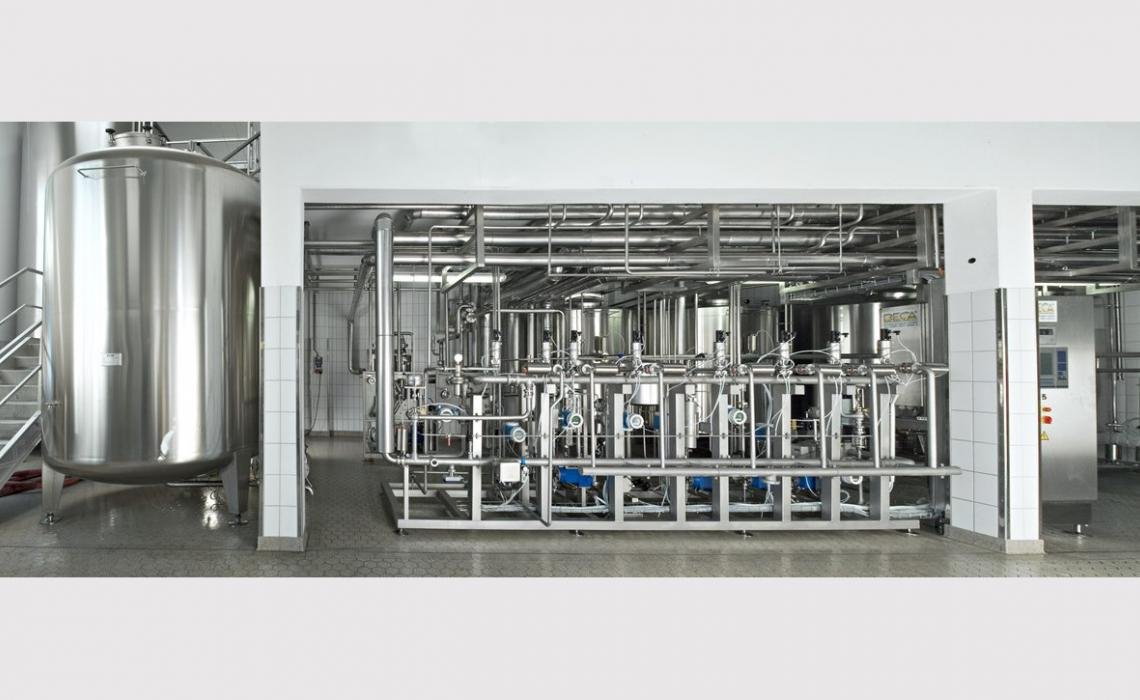
What is crossflow filtration and how does it work?
In tangential flow filtration, the fluid to be treated flows parallel to the active separation surface. This flow pattern continuously sweeps the membrane surface. Part of the liquid passes through the separation layer as filtrate or permeate, while larger particles and other retained components remain in the retentate.
This process is therefore also known as crossflow filtration. Unlike a separation stage with purely frontal flow, the suspension travels along the surface. The resulting shear forces can help prevent solids from accumulating on the filter surface and rapidly clogging it.
A defining feature is the combination of separation with continuous movement of the process stream along the separation zone. BECA® therefore considers not only the separation surface itself, but the entire process system.
Crossflow or dead-end filtration: what is the difference?
Both filtration methods perform a separation task, but differ significantly in flow direction and behavior at the filter surface.
Cross-Flow
In crossflow filtration, the process medium flows tangentially along the separation surface. Particles are therefore not forced solely against the membrane, but are partially carried onward with the process stream.
- Tangential flow along the membrane surface
- Reduced formation of a pronounced cake layer
- Suitable for continuous processing
- Retentate and permeate are routed separately
Dead-End Filtration
In dead-end filtration, the process medium flows essentially perpendicular to the separation surface. The liquid passes through the pores while solids are retained.
- Perpendicular flow through the separation surface
- Filter cake can build up during operation
- Flow resistance can increase as the cake layer grows
- Suitable for other specific separation tasks
The better filtration method depends on the specific product. Solids content, viscosity, temperature, required separation selectivity, transmembrane pressure and cleaning strategy must be evaluated together.
At BECA®, we therefore do not simply select a standard component. Each system is engineered around the specific process requirements.
How does tangential flow filtration reduce cake build-up and fouling?
Flow across the separation surface is one of the key differences from conventional filtration. In practice, this creates several process-engineering advantages.
Reduced Fouling
Tangential flow can reduce deposits on the surface and help prevent rapid fouling.
Continuous Processing
Permeate and retentate can be continuously separated and routed independently during operation.
Gentle Product Handling
Velocity, pressure, temperature and flow conditions can be adapted to the properties of the specific process medium.
Integrated Process Engineering
Pumps, piping, automation and cleaning can be engineered together as a complete process system.
In many separation processes, particles accumulate on the active surface. As this layer grows, hydraulic resistance can increase. Tangential flow across the membrane keeps the medium moving along the surface and can repeatedly carry particles away from it.
The resulting shear forces must be matched to the specific application. Maximum velocity is not automatically the best solution. Sensitive products should be handled as gently as possible, while other media can tolerate or require higher shear.
Gentle, quality-preserving processing therefore results from the interaction of velocity, pressure, temperature, geometry and product properties. The cleaning strategy also plays an important role. A correctly sized system can reduce fouling and clogging, supporting a long service life for the relevant components.
How do membrane, retentate and permeate work in crossflow filtration?
The membrane, or other separation medium used, largely determines which components pass through and which are retained. The feed stream is guided along the separation surface. One stream passes through the separation zone, while a second stream contains the retained components.
Depending on the process, either the filtrate or permeate, or the retentate, may be the desired product. In a concentration process, for example, the retained phase can be progressively concentrated. In clarification, the permeating phase is often the product of interest.
Undesired components can then be treated separately or discharged. Effective system design therefore starts not with the choice of a specific membrane type, but with the desired process result.
BECA® Filtration Solutions →Microfiltration and Ultrafiltration
Depending on the separation task, applications range from microfiltration to ultrafiltration. Separation ranges may be specified in µm or, for very fine applications, in nm. In addition to conventional module designs, hollow-fiber modules, hollow fibers or capillary membranes may also be used.
Which suspensions and liquids are suitable for crossflow filtration?
Crossflow can be suitable for a wide range of suspensions and industrial process media. In general, it is considered wherever components need to be separated from a liquid phase, concentrated or recovered.
Brewing & Beverage Industry
Clarification, recovery and product-specific separation tasks in liquid process streams.
Food Industry
Treatment and separation of suspensions and liquid product streams.
Wine & Fruit Juice
Quality-preserving processing as well as clarification and concentration.
Pharmaceutical Industry
Defined separation and concentration tasks with controlled process conditions.
The process medium is typically pumped through the system so that the filtration surface is continuously swept by the flow. How effectively a specific suspension can be processed depends, among other factors, on particle size, solids concentration, viscosity, temperature and chemical properties.
Product pretreatment and storage can also affect subsequent separation behavior. A specific application should therefore not be evaluated solely on theoretical parameters. Depending on the medium, process data, laboratory results or trials can provide an important basis for system design.
In food, wine or fruit-juice applications, a crossflow system can be used to remove particles, clarify product streams or further concentrate specific components. One potential process advantage is the elimination of filter aids, provided the crossflow process can replace the corresponding conventional process step.
This can simplify handling and disposal. Whether this is technically feasible and economically viable in a specific production process must be assessed individually.
Two crossflow principles. One solution engineered for your process.
The most suitable crossflow variant depends on the process medium, solids content, required throughput, process conditions and separation task. BECA® offers different technical concepts so that a single system principle does not have to be applied to every application.
Dynamic Crossflow
In dynamic crossflow, moving system elements additionally influence the hydrodynamic conditions at the separation surface. This allows relative motion between the separation surface and the product to be generated differently than in a system driven solely by fluid flow.
High solids content, product characteristics, required throughput or product sensitivity can influence the choice of this technology.
Explore Dynamic Crossflow →Static Inline Crossflow
In a static system, the required relative motion at the separation surface is generated primarily by the flow of the process medium. Pumping capacity, channel geometry and velocity largely determine conditions at the surface.
These concepts can be particularly suitable for compact, continuously operated process lines.
Explore Static Inline Crossflow →What advantages does tangential flow filtration offer in pharmaceutical and process engineering?
Tangential flow filtration is also used in pharmaceutical production and other areas of general process engineering for defined separation and concentration tasks. Depending on the process, particles, cell components or other constituents can be separated based on size and retention characteristics.
In addition to separation performance, materials of construction, hygienic design, cleanability, reproducible process conditions and reliable automation are important. Depending on the process medium, low-pressure operation or particularly gentle flow conditions may also be required.
The equipment must therefore be treated as an integrated process system. On request, BECA® combines process engineering design with planning, mechanical design, automation, installation and commissioning.
Crossflow is more than a membrane.
BECA® engineers the separation stage as part of a complete process plant. Pumps, tanks, piping, valves, instrumentation and control, cleaning systems and automation can all be designed as an integrated system.
This makes the concept particularly suitable for projects where crossflow should be integrated into the overall production line rather than engineered in isolation.
Process Analysis
Process medium, throughput, solids content and the required separation result form the basis for system design.
Process Engineering
Pump sizing, flow management, membrane concept, process parameters and cleaning are evaluated together.
Automation
Pressure, flow rates, temperatures and process states can be monitored and controlled.
Manufacturing & Integration
The crossflow stage can be integrated into new plants or existing production environments.
Commissioning & Service
BECA® supports projects through commissioning and can also provide service and lifecycle support.
What determines the cost efficiency of a crossflow filtration system?
The economics of an industrial plant depend on more than the purchase price. Product losses, throughput, energy consumption, cleaning requirements, plant availability, wear parts and potential downtime are equally important.
A technically well-matched system can be more economical over its service life than a lower-cost system that is poorly suited to the product. Especially with demanding process media, pump sizing, flow velocity, available membrane area and cleaning sequences must be coordinated.
Automation also plays an important role. Production, rinsing and cleaning sequences can be automated depending on the system concept, supporting reproducible operation.
When is a BECA® crossflow solution the right choice?
A crossflow solution is particularly attractive when demanding solid-liquid separation, recovery or concentration is required and conventional systems reach technical or economic limits.
What matters is not the label “crossflow” itself, but the result in the real process. The system must provide the required mass transfer, suit the process medium and operate reliably over the long term.
A BECA® solution can extend from the separation stage itself to pumps and piping, instrumentation and control, software, cleaning and commissioning. This makes the concept particularly suitable for companies seeking an integrated process-engineering solution rather than an isolated filtration machine.
Crossflow Filtration at a Glance
Crossflow combines a defined separation task with controlled flow along the membrane surface. The right technical solution always depends on the actual process.
- The process medium flows tangentially along the separation surface rather than only perpendicular to it.
- Crossflow can limit the formation of a pronounced cake layer.
- Retentate and permeate enable clarification, concentration and recovery processes.
- Membrane, pressure, velocity, temperature and product properties must be considered together.
- Crossflow is suitable for numerous applications in beverage, food, pharmaceutical and general process engineering.
- BECA® offers both dynamic and static inline crossflow solutions.
- Cleaning, automation, energy demand, product losses and plant availability all affect cost efficiency.
- BECA® can integrate crossflow from engineering through to a turnkey process solution.
Which crossflow solution fits your process?
Process medium, throughput, solids content, temperature and the required separation result form the basis for system design. Discuss your application directly with BECA®.