
Degassing Liquids: Effective Vacuum Operation and Correct Hydraulic Design
Degassing is a key process-engineering step whenever unwanted or disruptive gases need to be removed from a liquid. Effective performance depends on the interaction of pressure, temperature, flow management, system design and automation.
BECA® therefore treats degassing not as an isolated piece of equipment, but as an integrated part of a complete process solution.
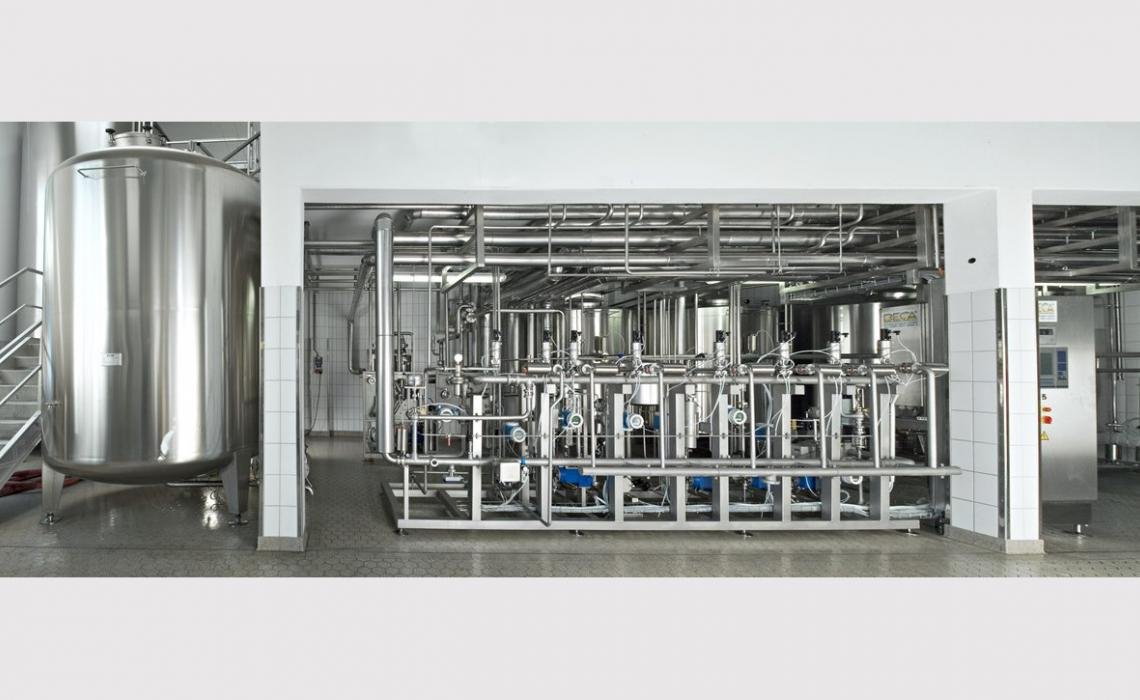
What happens when a liquid is degassed?
In many liquids, gases are not present only as visible bubbles but are physically dissolved in the liquid phase. The amount of gas a liquid can hold depends on the properties of the medium as well as temperature and pressure.
When process conditions change, dissolved components can leave the liquid phase again. Technical degassing uses these relationships to reduce defined gaseous components in a controlled manner.
A reliable system design must therefore consider not only the required final concentration, but also inlet conditions, volume, throughput, process time and integration into the surrounding plant.
Why can dissolved gases be problematic in industrial processes?
Depending on the application, dissolved gases can affect product quality, equipment performance and overall process stability. Oxygen is particularly important in many applications.
Product Quality
Oxygen can react with sensitive product components and promote unwanted quality changes.
Process Stability
Defined gas concentrations create reproducible conditions for downstream production stages.
Pumps & Instrumentation
Uncontrolled gas release can interfere with pumps, measuring points and other process components.
Reproducibility
Controlled degassing provides clearly defined conditions for subsequent process stages.
How does vacuum degassing work?
Vacuum degassing lowers the pressure above the liquid significantly below atmospheric pressure. This changes the equilibrium between the liquid and gas phases.
Dissolved gaseous components can leave the liquid and subsequently be removed from the process chamber.
An effective exchange surface between the liquid and gas space is essential. Depending on the system design, the medium may be distributed, sprayed or guided across suitable internals.
Maximum vacuum alone does not determine process quality. Product properties, initial gas load, required residual concentration and throughput must be evaluated together.
Explore Vacuum Degassing →Vacuum alone is not a process design.
Simply connecting a vacuum pump to a vessel is not sufficient for a properly engineered degassing system.
Liquid inlet, distribution, gas space, gas removal, pump technology, valves and control must operate as one coordinated system.
Reduced pressure may also cause part of the process medium to evaporate. Degassing performance, gentle product handling and energy consumption must therefore be balanced.
Which technologies are available in addition to vacuum degassing?
Not every application requires the same technical principle. The most suitable solution depends on the medium, process conditions, required separation result and existing infrastructure.
Membrane Degassing
Suitable membranes separate the liquid and gas phases. Mass transfer across the membrane can be supported by controlled pressure conditions.
Learn More →Column Degassing
Column systems provide controlled mass transfer between the liquid and gas phases through suitable internals and defined flow conditions.
Learn More →Thermal Degassing
Controlled temperature management changes gas solubility and can support the removal of dissolved gaseous components.
Learn More →Why is hydraulic design so important in a degassing system?
Even a highly effective separation stage can only perform reliably when the process medium is routed through the system correctly.
A degassing plant must therefore be hydraulically matched to throughput, pressure losses, vessel volume, pump performance and piping layout.
Process engineering and hydraulic design together determine whether the required degassing performance can be maintained under real production conditions.
Throughput & Pipe Diameters
Pipe dimensions must match the actual flow rate and permissible flow velocities.
Pressure Losses
Piping, valves and equipment affect the available pressure conditions throughout the system.
Static Head
Elevation differences between vessels and equipment influence hydraulic operating conditions.
Pump Sizing
Pump head and operating curve must suit the complete process rather than an isolated component.
Flow Management
Poor inlet conditions or local pressure changes can trigger gas release at unwanted locations.
What role do oxygen and nitrogen play in degassing?
The gases to be removed depend strongly on the product and process. Initial gas load, solubility behavior and required target values are the key engineering parameters.
Oxygen
In beverages, water and sensitive process media, reducing oxygen can help limit oxidative product changes.
Nitrogen
Depending on the medium and operating conditions, nitrogen may also contribute significantly to the dissolved gas load.
Carbon Dioxide
Depending on the product, dissolved carbon dioxide may also form part of the process-engineering requirement.
Mixed Gas Loads
Gas composition, inlet concentration, required outlet values and operating fluctuations must all be considered.
Where is industrial liquid degassing typically used?
Degassing stages are used across a wide range of industrial liquid processes. The technical design is always adapted to the specific process medium.
Beverage & Brewing
Reduction of unwanted dissolved gases in water and liquid product streams.
Food Industry
Degassing of sensitive process media under controlled operating conditions.
Pharma & Chemicals
Controlled gas reduction for technically or qualitatively demanding liquids.
Water & Energy
Degassing of water, technical circuits and media used in energy-related applications.
Ultrapure Water
Solutions for demanding water qualities and very low residual gas concentrations.
Ultrapure Water Degassing →Geothermal Media
Process concepts adapted to geothermal fluids and their specific operating conditions.
Geothermal Degassing →Refrigerants
Specialized degassing concepts for process media with specific physical properties.
Refrigerant Degassing →How can water and energy consumption be optimized?
Economic performance depends on more than separation efficiency. Pumps, vacuum generation, cooling, heating and utility media all consume energy.
Some system concepts also use water as an operating medium. An optimized process therefore considers not only the achievable gas concentration but also the resources required to achieve it.
Depending on the system concept, recirculation loops and other technical measures can reduce water and utility consumption.
Seal-Water Degassing →What determines the process reliability of a degassing system?
Stable degassing performance requires reproducible operating conditions. Variations in feed conditions, temperature, gas load or throughput can affect the result.
Instrumentation and control systems allow relevant process variables to be monitored continuously and the plant to operate within defined ranges.
Maintenance, cleaning and access to critical components should also be considered during system design.
Measurement
Pressure, temperature, flow rate and other relevant process variables are monitored continuously.
Control
Pumps, pressure control and other components are integrated into defined operating sequences.
Automation
Automated sequences help maintain reproducible process conditions.
Visualization
Plant status and process values are displayed transparently for operation and diagnostics.
When does a customized BECA® solution make sense?
In demanding applications, an isolated standard component is often not enough. The liquid to be degassed must be considered as part of the complete production process.
Process Engineering
Analysis of the medium, gas load, target values and required operating conditions.
Mechanical Design
Engineering of vessels, pumps, piping, valves and the actual degassing stage.
Automation
Integration of S7/TIA programming, instrumentation, process control and visualization.
Turnkey
Integration of the degassing stage into a complete process and production plant.
Liquid Degassing at a Glance
Reliable degassing results from the coordinated interaction of process engineering, hydraulics, plant design and automation.
- Dissolved gases can affect the quality and stability of industrial liquid processes.
- Medium, throughput, gas load and target concentration determine the technical design.
- Reduced pressure can promote the release of dissolved gases, but vacuum generation alone is not sufficient.
- Vacuum, membrane, column and thermal technologies are available for different process requirements.
- Correct flow management is just as important as the separation technology itself.
- Oxygen, nitrogen, carbon dioxide and other gases must be assessed according to the specific application.
- Energy demand, water consumption, cleaning and automation directly influence operating economics.
- BECA® provides solutions for general process media, ultrapure water, geothermal applications and other specialized media.
- Pumps, piping, instrumentation, control and automation can be integrated into a complete process plant.
- BECA® can provide engineering through to turnkey integration.
Which degassing solution fits your process?
Process medium, throughput, gas load, temperature, pressure conditions and the required residual gas concentration form the basis for system design.